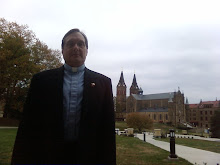
I mentioned before that in my work life I serve as a chaplain for a residential facility for developmentally disabled adults. We are in the process of building a chapel and I provided you with a link to the website for the chapel, so you could follow our progress. Well, the website now has a new address. Our new web address is http://hazelwoodchapel.com Be sure to check it out and please continue to pray for our success in this endeavor.
Peace,
Deacon John
Thursday, November 16, 2006


Tuesday, November 14, 2006
Tuesday of the 32nd Week in Ordinary Time
Ti 2:1-8, 11-14
Lk 17:7-10
If you have ever taken care of a small child, say 3 or 4 years old, you have had the experience of getting that child to do something they do not want to do. The more you push, the harder they resist, until it becomes a monumental battle of wills, a battle which you may well lose. As the battle rages the child will finally turn to you and shout, “You’re not the boss of me!” It may be frustrating to hear those words, but you will hear them, because that child, like all of us, has a stubborn streak. None of us likes to be told what to do. Admit it, when someone comes to you and says you have to do this, what is your initial reaction? No I don’t have to do it either. And you can’t make me. You may even think or perhaps say, “You’re not the boss of me!” And you’re not even three years old. We just don’t like being told what to do. So what do we find in the first reading from Titus? Someone apparently telling us what to do! Older men are to be temperate and dignified, older women are to be reverent and not slander. Younger women are to learn to be good housekeepers and to be under the control of their husbands (ha! try that in my house!). Younger men are to be self-controlled and respectful; you get the idea, a lot of stuff that we are supposed to do. If the people who read this originally are like people today their reaction may have been “you’re not the boss of me!” Before we react like spoiled children, perhaps we should look at these admonitions in a different way. Perhaps we need to look at them not as things we have to do, but as things we are supposed to be. That is a very different proposition. These aren’t the beginning of the process, the things that I do that make me Christian, They are more like the end of the process, the things I will be if I am a Christian. None of them are things we can do alone. We must have help, the help of God, the help of the Holy Spirit. In Galatians Paul speaks of the gifts of the Holy Spirit. “In contrast, the fruit of the Spirit is love, joy, peace, patience, kindness, generosity, faithfulness, gentleness, self-control.” (Gal. 5: 22-23) They sound a lot like the things we are called upon to be in Titus. But they aren’t really the end of the process, they are the process. They are the things we are, if we allow the Spirit to work through us. We won’t always make it, we will fail and fall back into our old stubborn ways, but we will succeed as well. They are the things we are if instead of spoiled children, we allow ourselves to be the children of God.
Deacon John
Tuesday of the 32nd Week in Ordinary Time
Nov. 14, 2006
Lk 17:7-10
If you have ever taken care of a small child, say 3 or 4 years old, you have had the experience of getting that child to do something they do not want to do. The more you push, the harder they resist, until it becomes a monumental battle of wills, a battle which you may well lose. As the battle rages the child will finally turn to you and shout, “You’re not the boss of me!” It may be frustrating to hear those words, but you will hear them, because that child, like all of us, has a stubborn streak. None of us likes to be told what to do. Admit it, when someone comes to you and says you have to do this, what is your initial reaction? No I don’t have to do it either. And you can’t make me. You may even think or perhaps say, “You’re not the boss of me!” And you’re not even three years old. We just don’t like being told what to do. So what do we find in the first reading from Titus? Someone apparently telling us what to do! Older men are to be temperate and dignified, older women are to be reverent and not slander. Younger women are to learn to be good housekeepers and to be under the control of their husbands (ha! try that in my house!). Younger men are to be self-controlled and respectful; you get the idea, a lot of stuff that we are supposed to do. If the people who read this originally are like people today their reaction may have been “you’re not the boss of me!” Before we react like spoiled children, perhaps we should look at these admonitions in a different way. Perhaps we need to look at them not as things we have to do, but as things we are supposed to be. That is a very different proposition. These aren’t the beginning of the process, the things that I do that make me Christian, They are more like the end of the process, the things I will be if I am a Christian. None of them are things we can do alone. We must have help, the help of God, the help of the Holy Spirit. In Galatians Paul speaks of the gifts of the Holy Spirit. “In contrast, the fruit of the Spirit is love, joy, peace, patience, kindness, generosity, faithfulness, gentleness, self-control.” (Gal. 5: 22-23) They sound a lot like the things we are called upon to be in Titus. But they aren’t really the end of the process, they are the process. They are the things we are, if we allow the Spirit to work through us. We won’t always make it, we will fail and fall back into our old stubborn ways, but we will succeed as well. They are the things we are if instead of spoiled children, we allow ourselves to be the children of God.
Deacon John
Tuesday of the 32nd Week in Ordinary Time
Nov. 14, 2006
Thursday, November 09, 2006
Friday Memorial of St. Leo the Great
Phil 3:17—4:1
Lk 16:1-8
It seems odd that a man would commend someone for giving away what was not that his to give away. Indeed, the property in question belongs to the man doing the commending. I can’t imagine that I would be really happy with someone who was giving away my stuff, especially after I had already caught him being dishonest. But here, in this Gospel reading, that is exactly what the master does. The dishonest servant seeks to save himself by ingratiating himself with others who owe his master. The key to this conundrum may lie in the last lines of the Gospel. “For the children of this world are more prudent in dealing with their own generation than the children of light.” Only another thief would appreciate what the dishonest servant did. They share in common their dishonesty. We can find ourselves caught up in those dealings, in the worries of the world, in things that, at the end of the day do not matter. If we build our lives around stuff, if we build our lives around trivia, we find ourselves in the end standing in the dark. If we move to the light, if we begin to live as children of light, we begin to see, to see the things that are really important, and to recognize the things that are not.
Deacon John
Memorial of St. Leo the Great, Pope and Doctor of the Church
Nov. 10, 2006
Lk 16:1-8
It seems odd that a man would commend someone for giving away what was not that his to give away. Indeed, the property in question belongs to the man doing the commending. I can’t imagine that I would be really happy with someone who was giving away my stuff, especially after I had already caught him being dishonest. But here, in this Gospel reading, that is exactly what the master does. The dishonest servant seeks to save himself by ingratiating himself with others who owe his master. The key to this conundrum may lie in the last lines of the Gospel. “For the children of this world are more prudent in dealing with their own generation than the children of light.” Only another thief would appreciate what the dishonest servant did. They share in common their dishonesty. We can find ourselves caught up in those dealings, in the worries of the world, in things that, at the end of the day do not matter. If we build our lives around stuff, if we build our lives around trivia, we find ourselves in the end standing in the dark. If we move to the light, if we begin to live as children of light, we begin to see, to see the things that are really important, and to recognize the things that are not.
Deacon John
Memorial of St. Leo the Great, Pope and Doctor of the Church
Nov. 10, 2006
Wednesday, November 08, 2006
Wednesday of the 31st Week in Ordinary Time
Phil 2:12-18
Lk 14:25-33
To give, without counting the cost. Many of us would view that as the epitome of love. Emptying oneself, without consideration for oneself, would seem to be the ultimate good one can do. The Apostle Paul asks the Philippians to do just that. “Do everything without grumbling or questioning, that you may be blameless and innocent, children of God without blemish.” In the Gospel reading Jesus seems to be saying something quite different. Jesus asks if one would be foolish enough to start a building without first being certain of having the resources to finish the job. A king would never enter into battle without first calculating what the chances he may have of succeeding. Selfless giving? Looks more like calculated giving, giving designed to maximize return. Ah, but to really understand what Jesus is saying we must look at what he says in the beginning, “Whoever does not carry his own cross and come after me cannot be my disciple.” Jesus does want us to calculate the cost, not the value of what we may receive, but the cost of what we surrender. We are being called to a selfless giving, a total gift to God of the only thing we have of value, ourselves. Jesus says follow me, but look at what that entails. Be prepared to give up everything, everything, to truly follow me. I’m not so sure that too many of us are ready to make those calculations. It’s scary to look at what we may have to give up, but look at what we have to gain. When we take up our cross, when we finally give selflessly then we “may be blameless and innocent, children of God without blemish in the midst of a crooked and perverse generation,among whom you shine like lights in the world,”
Peace,
Deacon John
Wednesday of the 31st Week in Ordinary Time
Nov. 8, 2006
Lk 14:25-33
To give, without counting the cost. Many of us would view that as the epitome of love. Emptying oneself, without consideration for oneself, would seem to be the ultimate good one can do. The Apostle Paul asks the Philippians to do just that. “Do everything without grumbling or questioning, that you may be blameless and innocent, children of God without blemish.” In the Gospel reading Jesus seems to be saying something quite different. Jesus asks if one would be foolish enough to start a building without first being certain of having the resources to finish the job. A king would never enter into battle without first calculating what the chances he may have of succeeding. Selfless giving? Looks more like calculated giving, giving designed to maximize return. Ah, but to really understand what Jesus is saying we must look at what he says in the beginning, “Whoever does not carry his own cross and come after me cannot be my disciple.” Jesus does want us to calculate the cost, not the value of what we may receive, but the cost of what we surrender. We are being called to a selfless giving, a total gift to God of the only thing we have of value, ourselves. Jesus says follow me, but look at what that entails. Be prepared to give up everything, everything, to truly follow me. I’m not so sure that too many of us are ready to make those calculations. It’s scary to look at what we may have to give up, but look at what we have to gain. When we take up our cross, when we finally give selflessly then we “may be blameless and innocent, children of God without blemish in the midst of a crooked and perverse generation,among whom you shine like lights in the world,”
Peace,
Deacon John
Wednesday of the 31st Week in Ordinary Time
Nov. 8, 2006
Monday, November 06, 2006
Shameless self-promotion (sort-of)
In my work life I serve as chaplain in a residential facility for developmentally disabled adults. One of our great needs has been a space dedicated to worship, reflection, meditation, and prayer. With God's grace we have begun to build a new building designed to house this chapel area. We have started, but we still have a long way to go. You can check out the building and follow our progress at www.jamesmohnfund.com Keep us and our efforts in your prayers.
Peace,
Deacon John
Peace,
Deacon John
Monday of the 31st Week in Ordinary Time
Phil 2:1-4
Lk 14:12-14
How much of what we do, do we expect repayment for? If not explicitly than at least implicitly? I’m not impugning any one’s integrity, or doubting that what we do may be for purely altruistic reasons, but how often do we at least think we’ll be repaid? It scares me to think about how many times it ran through my mind that I might be doing a good deed hoping that it would come back to me, that it would be to my credit. We seem to act like we believe in karma, even though that is surely not a part of our belief system. In the Gospel reading Jesus is asking us to act without expecting anything in return. Do good for those who cannot possibly repay you. Even then it seems to be a Catch-22, we try to do good, not explicitly looking for a reward, but in the back of our minds the idea of repayment in some form exists. Now, this isn’t all bad, it does serve to motivate good behavior, sort of like tax breaks for charitable donations. Jesus isn’t asking us to do the impossible, to completely ignore the possibility our good works may work for us. What we need to question is our primary motivation for the things we do. Do we act solely in expectation of reward? Or, is the possibility of reward only a dim idea floating in the back of our minds? Maybe that is where Jesus wants us, acting for the good, helping others, and as a by-product, helping ourselves.
Deacon John
Monday of the 31st Week in Ordinary Time
Nov. 6, 2006
Lk 14:12-14
How much of what we do, do we expect repayment for? If not explicitly than at least implicitly? I’m not impugning any one’s integrity, or doubting that what we do may be for purely altruistic reasons, but how often do we at least think we’ll be repaid? It scares me to think about how many times it ran through my mind that I might be doing a good deed hoping that it would come back to me, that it would be to my credit. We seem to act like we believe in karma, even though that is surely not a part of our belief system. In the Gospel reading Jesus is asking us to act without expecting anything in return. Do good for those who cannot possibly repay you. Even then it seems to be a Catch-22, we try to do good, not explicitly looking for a reward, but in the back of our minds the idea of repayment in some form exists. Now, this isn’t all bad, it does serve to motivate good behavior, sort of like tax breaks for charitable donations. Jesus isn’t asking us to do the impossible, to completely ignore the possibility our good works may work for us. What we need to question is our primary motivation for the things we do. Do we act solely in expectation of reward? Or, is the possibility of reward only a dim idea floating in the back of our minds? Maybe that is where Jesus wants us, acting for the good, helping others, and as a by-product, helping ourselves.
Deacon John
Monday of the 31st Week in Ordinary Time
Nov. 6, 2006
Wednesday, November 01, 2006
All Souls Day
Wis 3:1-9
Rom 5:5-11
Jn 6:37-40
I have to admit, I worry. I worry about lots of things, most of them completely out of my control. Some worries are irrational, some are understandable, but almost none of them are things I can control. I worry about my daughter, my wife, my mother, my sister, my brother, my friends, you get the picture. I worry, and that brings us to today, All Souls Day, the day we remember all of those who have gone before us. Yesterday we celebrated the Feast of All Saints, everyone who has made it to the bigs, whether we know them or not. Today we celebrate everyone, especially those whose disposition is, shall we say, unknown. And that makes me worry. All of us have lost people close to us, people we loved, but people, human beings, subject to all of the frailties and failings that being human can mean. That leads to worry, one of those worries about something that I have absolutely no control over. I don’t have any control, but that doesn’t mean there is nothing I can do. There is much I can do because I can pray. I can pray for those who have gone on before; I can pray that they reach the ultimate glory. I pray because I love (yes love, not loved) them, and want only for them to be with God, to enjoy the perfect peace and love that is Heaven. I pray so that one day they can pray for me, who will undoubtedly need their help and a great deal more. I pray and I worry, but I also find comfort, comfort in today’s Gospel. Jesus says “Everything that the Father gives me will come to me, and I will not reject anyone who comes to me.” Later Jesus says “For this is the will of my Father, that everyone who sees the Son and believes in him may have eternal life, and I will raise him up on the last day.” Everyone who believes, not everyone who is perfect, not everyone who is without fault. God wants us, all of us. Sure, we can still mess it up, but God still wants us, all of us. I find that thought very comforting indeed. Hope for me, hope for those I love, hope for all of us is there, there in the boundless love of God. Maybe today I can worry just a little less.
Deacon John
Feast of All Souls
Nov. 2, 2006
Rom 5:5-11
Jn 6:37-40
I have to admit, I worry. I worry about lots of things, most of them completely out of my control. Some worries are irrational, some are understandable, but almost none of them are things I can control. I worry about my daughter, my wife, my mother, my sister, my brother, my friends, you get the picture. I worry, and that brings us to today, All Souls Day, the day we remember all of those who have gone before us. Yesterday we celebrated the Feast of All Saints, everyone who has made it to the bigs, whether we know them or not. Today we celebrate everyone, especially those whose disposition is, shall we say, unknown. And that makes me worry. All of us have lost people close to us, people we loved, but people, human beings, subject to all of the frailties and failings that being human can mean. That leads to worry, one of those worries about something that I have absolutely no control over. I don’t have any control, but that doesn’t mean there is nothing I can do. There is much I can do because I can pray. I can pray for those who have gone on before; I can pray that they reach the ultimate glory. I pray because I love (yes love, not loved) them, and want only for them to be with God, to enjoy the perfect peace and love that is Heaven. I pray so that one day they can pray for me, who will undoubtedly need their help and a great deal more. I pray and I worry, but I also find comfort, comfort in today’s Gospel. Jesus says “Everything that the Father gives me will come to me, and I will not reject anyone who comes to me.” Later Jesus says “For this is the will of my Father, that everyone who sees the Son and believes in him may have eternal life, and I will raise him up on the last day.” Everyone who believes, not everyone who is perfect, not everyone who is without fault. God wants us, all of us. Sure, we can still mess it up, but God still wants us, all of us. I find that thought very comforting indeed. Hope for me, hope for those I love, hope for all of us is there, there in the boundless love of God. Maybe today I can worry just a little less.
Deacon John
Feast of All Souls
Nov. 2, 2006
Subscribe to:
Posts (Atom)